DEPLOYED YOUR WAY
- BYO-Kernel
- On-prem
- Air-gapped
- HTTP / API lane
- License-only
- White-label
- OEM
- Your keys
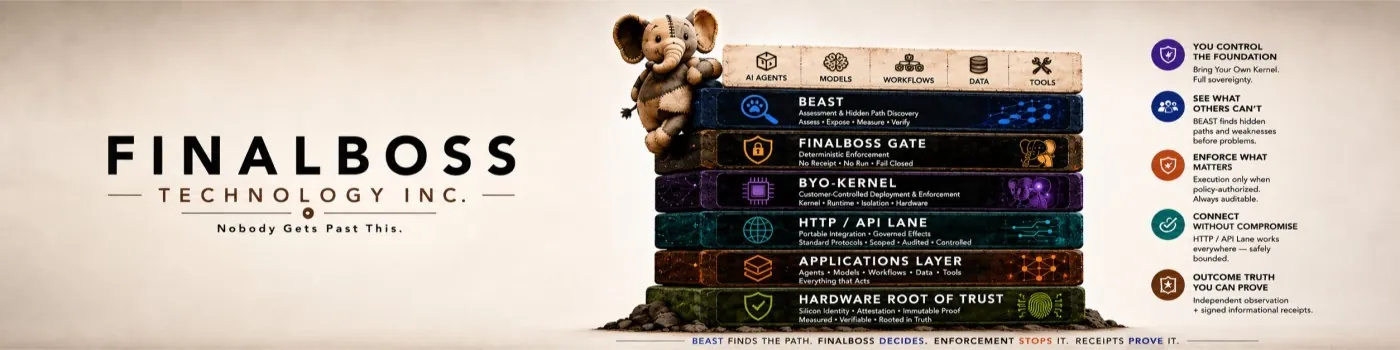
BYO-Kernel execution control for AI
NOBODY GETS PAST THIS.
Your AI doesn't act until says yes.
Bring your own kernel. FinalBoss runs inside it, on your hardware, and every action an AI tries has to pass it first. Allowed actions run with a signed receipt. Everything else is stopped before it happens.
Every request stops at the Gate. Only a yes runs, with a signed receipt.
FinalBoss technology brief
Execution security for agentic AI.
The core system is not a roadmap. It is built, running, and patent-pending. Gate, BEAST, token and inference-path mapping, kernel-level enforcement, receipts signed Ed25519 + ML-DSA-87, and standalone verification already exist.
BEAST maps the path under attack.
Gate controls the consequence.
Verify preserves what can be proven.
36
Patent applications pending since 2025
4
Nonprovisionals pending
PCT
10 provisionals consolidated into it
ML-DSA-87
Post-quantum, dual-signed with Ed25519
ABOVE PROPOSES. BELOW DECIDES. NO RECEIPT. NO RUN.
NOW TAKING FOUNDING DEPLOYMENT PARTNERS
How it works
One loop. Nothing gets around it.
What you get
Everything that acts, under your control.
You control the foundation
Bring your own kernel. Full sovereignty.
FinalBoss installs into the kernel you already run, on your servers, with your keys. Enforcement happens at the operating system, where an agent can't route around it.
See what others can't
BEAST finds hidden paths and weaknesses before they become problems.
Enforce what matters
Execution only when policy-authorized. Always auditable.
Connect without compromise
The HTTP/API lane plugs in over standard protocols. Scoped, audited, controlled.
Outcome truth you can prove
Independent observation plus signed receipts. Your auditors check them offline.
Delivered your way
Your kernel. Your hardware. Your keys.
Proof
Tested on real hardware.
Every number traces to a sealed run with a published hash.
AMD SEV-SNP · endurance
Receipts in one unbroken chain. No gaps, no duplicates, zero fail-opens.
NVIDIA H100 · 3,000 requests
Stopped. Only the 4 with permission ran.
Hospital · scenarios
Decided correctly, from a clean start.
Live
Above proposes. Below decides.
Your AI asks. FinalBoss decides at the line. Only a yes reaches the real world.
Above · your AI proposes
Below · the real world · only a yes arrives
If FinalBoss is switched off, nothing gets through.
Try it
You're the AI. Ask for something.
This agent may only read one account and send that customer a reminder. Try anything else.
Above · the AI asks
Below · FinalBoss decides
Denied
No authority for this payment. Nothing moved.
Real SHA-256 and Ed25519, running in your browser with a key made for this visit.Now try to cheat it →
Who it's for
For the people who answer for what AI does.
PATENT APPLICATIONS PENDING
SINCE 2025
Built first. Then patented.
The spine is U.S. Application No. 19/770,293, filed internationally as PCT/US26/40488.
ALLOWED
NONPROVISIONALS PENDING
PROVISIONALS FOLDED INTO THE SPINE
U.S. 19/240,581 ALLOWED SEPT 29, 2026 · CONTINUATION AND TWO CIPS PENDING